782.lbm_r
Computational Fluid Dynamics, Lattice Boltzmann Method
Thomas Pohl <thomas.pohl [at] gmail [dot] com>
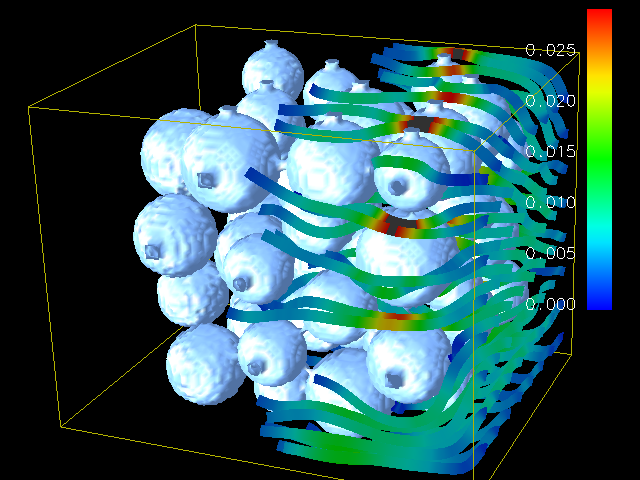
This program implements the so-called "Lattice Boltzmann Method" (LBM) to simulate incompressible fluids in 3D as described in [1]. It is the computationally most important part of a larger code which is used in the field of material science to simulate the behavior of fluids with free surfaces, in particular the formation and movement of gas bubbles in metal foams. For benchmarking purposes and easy optimization for different architectures, the code makes extensive use of macros which hide the details of the data access. A visualization of the results of the submitted code can be seen below (flow through a porous medium, grid size 200x200x130, 1200 time steps).
Flow of a fluid through an array of spheres
The lbm program requires several command line arguments:
lbm <time steps> <result file> <0: nil, 1: cmp, 2: str> <0: ldc, 1: channel flow> [<obstacle file>]
Description of the arguments:
The basic steps of the simulation code are as follows:
For benchmarking purposes, where the SPEC® tools are used to validate the solution, only the computed results are stored.
In the Lattice Boltzmann Method, a steady state solution is achieved by running a sufficient number of model time steps. For the refrate workload, 1200 time steps are computed for an obstacle file. The simulation domain is x=200, y=200 and z=130.
The geometry used in the test and training workload is the same as used in the reference benchmark workload with fewer timesteps.
The file format which specifies the location of obstacle and fluid cells is a simple ASCII format. The dot character '.' stands for a fluid cell, while all other characters (here '#') denote an obstacle cell. Each line represents the cells along the x axis. After each line a newline has to be included. After a complete x/y plane another newline has to be included.
Below you see an example of an obstacle file for the simulation domain x = 6, y = 5, and z = 3. The red comments just show the corresponding coordinates for each line and must not be included in the obstacle file itself.
......                (y = 0, z = 0)
...#..                (y = 1, z = 0)
..##..                (y = 2, z = 0)
.###..                (y = 3, z = 0)
......                (y = 4, z = 0)

......                (y = 0, z = 1)
......                (y = 1, z = 1)
...#..                (y = 2, z = 1)
..##..                (y = 3, z = 1)
......                (y = 4, z = 1)

......                (y = 0, z = 2)
......                (y = 1, z = 2)
......                (y = 2, z = 2)
...#..                (y = 3, z = 2)
......                (y = 4, z = 2)
By default, the benchmark uses action '0' and no output file is generated. Instead, the statistical summary information is printed to stdout and used for validation.
If the store action '2' is specified in the command line arguments, a result file containing the 3D velocity vector for each cell is stored.
The default file format is a sequence of binary single precision values (little endian) with the following ordering:
vx(0,0,0), vy(0,0,0),
vz(0,0,0), vx(1,0,0),
vy(1,0,0), vz(1,0,0),
vx(2,0,0), vy(2,0,0),
vz(2,0,0),
...,
vx(X,0,0) vy(X,0,0) vz(X,0,0),
vx(0,1,0), vy(0,1,0),
vz(0,1,0), vx(1,1,0),
vy(1,1,0), vz(1,1,0),
vx(2,1,0), vy(2,1,0),
vz(2,1,0),
...,
vx(X,1,0) vy(X,1,0) vz(X,1,0),
...
vx(0,Y,0), vy(0,Y,0),
vz(0,Y,0), vx(1,Y,0),
vy(1,Y,0), vz(1,Y,0),
vx(2,Y,0), vy(2,Y,0),
vz(2,Y,0),
...,
vx(X,Y,0) vy(X,Y,0) vz(X,Y,0),
...
vx(0,Y,Z), vy(0,Y,Z),
vz(0,Y,Z), vx(1,Y,Z),
vy(1,Y,Z), vz(1,Y,Z),
vx(2,Y,Z), vy(2,Y,Z),
vz(2,Y,Z),
...,
vx(X,Y,Z) vy(X,Y,Z) vz(X,Y,Z)
Although the default format cannot be altered via command line arguments, it is possible to change the output precision to double precision in config.h.
If the computed result should be compared to an existing result (action '1'), the program returns the maximum absolute difference of the velocity comparing each cell individually. If the difference is smaller than a certain threshold, the two results are considered to be equal.
ANSI C
782.lbm_r is highly similar to 519.lbm_r, with the exception that the CPU 2026 version has been resized to use 1.6 GiB of memory, which is about 4 times the size of the CPU 2017 version. SPEC decided to retain the benchmark in the new CPU 2026 suite because it significantly exercises main memory.
When using larger inputs than those included with the the refrate workload, systems that do not support allocation of large static arrays may need to use the portability flag "SPEC_LBM_NO_HUGE_ARRAY".
LBM is licensed directly to SPEC by the author, Thomas Pohl.
Copyright © 2026 Standard Performance Evaluation Corporation (SPEC®)